
Access Nash County Criminal Court Records
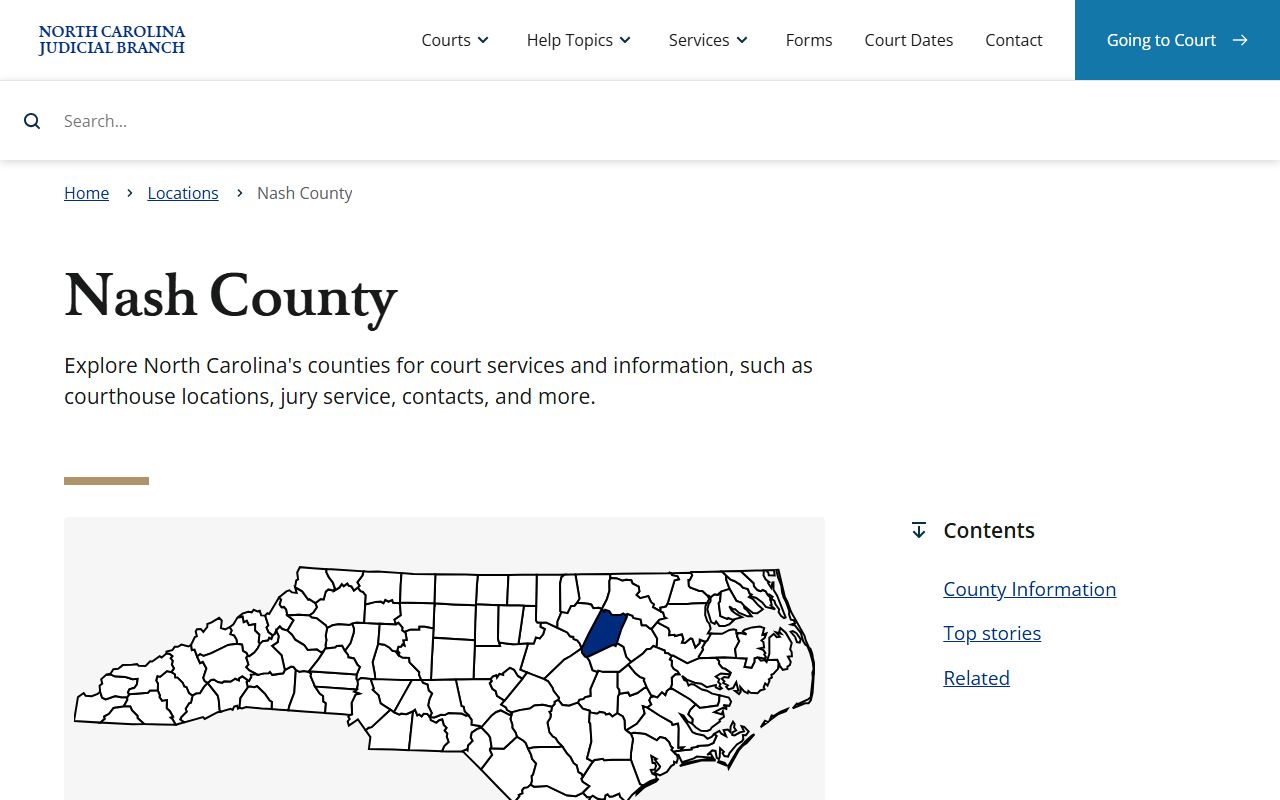
Nash County criminal court records are maintained by the Clerk of Superior Court in Nashville. The county is in the eastern Piedmont area of North Carolina. Rocky Mount, the largest city, sits partly in Nash County. The clerk office stores all criminal case files from District and Superior Court. Records are open to the public. You can search for cases at the courthouse or through the state online portal. Nash County has both a main courthouse in Nashville and a judicial center in Rocky Mount.
Nash County Quick Facts
Nash County Criminal Court Records Clerk
The Clerk of Superior Court manages all court records in Nash County. The main office is at the courthouse in Nashville. A second location operates at the Rocky Mount Judicial Center. Both serve Nash County residents.
You can visit the Nash County NC Courts page for the full contact directory, court calendars, and local rules. The clerk office is open Monday through Friday. Hours at the Nashville courthouse run from 8:30 AM to 12:30 PM and 1:30 to 5:00 PM. Thursday hours shift slightly. Magistrates in Nashville can be reached at (252) 220-3019. The Rocky Mount magistrate office number is (252) 212-3119.
Public terminals at both locations let you search criminal records on your own in Nash County.
| Court |
Nash County Clerk of Superior Court Nash County Courthouse Nashville, NC 27856 Phone: (252) 220-3000 |
|---|---|
| Hours | Monday through Friday, 8:30 AM to 5:00 PM (lunch break varies) |
| Website | nccourts.gov/locations/nash-county |
Search Nash County Criminal Court Records
Searching criminal court records in Nash County can be done online, in person, or by mail. The approach you choose depends on what type of record you need and how you plan to use it.
For a quick check, use the NC eCourts portal. It is free. You can search by name, case number, or citation number. The portal covers all counties, including Nash County. Basic case data like charges, court dates, and outcomes are shown. You do not need an account for this. The portal runs 24 hours a day, 7 days a week.
For certified results, use Form AOC-CR-314. Get it from the NC Courts forms page. The fee is $25 per name. Submit it at the Nash County clerk office or mail it in. The certified search carries the court seal and is accepted for legal purposes. This is the standard way to run a criminal record check in Nash County.
In person, you can also view the paper case file. Ask the clerk to pull the file you need. You can read through it and request copies. Copy fees are $2 for the first page and $0.25 after that. The Nashville courthouse and Rocky Mount location both offer these search options for Nash County residents.
Criminal Court Cases in Nash County
Nash County courts handle a wide range of criminal matters. The District Attorney for District 8 prosecutes cases here. The DA office is at (252) 212-3110.
District Court in Nash County hears misdemeanors and infractions. This includes DWI, simple assault, shoplifting, and traffic matters. A judge decides these cases without a jury. If a defendant wants a jury trial on a misdemeanor, the case moves to Superior Court on appeal. Superior Court handles all felonies in Nash County. Drug trafficking, armed robbery, murder, and burglary cases are tried here. A 12-person jury hears felony cases when the defendant pleads not guilty.
Every criminal case in Nash County creates a court file. The file holds all the papers from start to finish. Warrants, motions, plea forms, verdicts, and sentencing orders all go into the record. These files stay at the clerk office in Nash County. Most are open to public view under the North Carolina Public Records Act.
Note: Warrants that have not been served are restricted from public view until they are returned.
Nash County Criminal Record Fees
Fees apply when you request copies of criminal court records in Nash County. The clerk office collects payment when you make the request.
A certified criminal record search costs $25 per name. This uses Form AOC-CR-314. You can submit it at the Nashville courthouse or the Rocky Mount location. Uncertified copies are $2 for the first page and $0.25 per page after that. Certified copies of individual documents cost $3 each. These fees are the same across North Carolina. The eCourts portal is free for basic case lookups. Call (252) 220-3000 to confirm payment methods before you visit the Nash County clerk office.
Access Nash County Criminal Court Records
Criminal court records in Nash County are public under the North Carolina Public Records Act, N.C.G.S. Chapter 132. Anyone can request to view them. You do not have to be a party in the case.
Some records are restricted. Unreturned warrants are not available in Nash County until they are served. Juvenile cases are confidential under state law. Sealed and expunged records are not open to the public. Involuntary commitment cases and some protective orders require elevated access. The clerk can tell you if a file has any restrictions when you ask. For more details, the NC Courts guide to records explains what is and is not available.
State Resources for Nash County Records
Beyond the local clerk office, state tools can help you find criminal data tied to Nash County. The NC Department of Adult Correction has an offender search that goes back to 1972. This tracks people who went to state prison or were on probation. It does not include local jail records from Nash County.
The NC SBI processes fingerprint-based criminal checks. These are the most accurate type. The SBI is the central repository for criminal records in North Carolina. They also run the sex offender registry. You can look up registered offenders near any address in Nash County through that site.
The Nash County Sheriff Office at 252-459-4121 handles arrest records and jail data. For court case files and sentencing records, the Clerk of Superior Court is the right office. These are two separate record systems in Nash County.
Nearby Counties
These counties border Nash County. Rocky Mount straddles the Nash and Edgecombe county line, so some cases may be in one county or the other based on where the offense occurred.